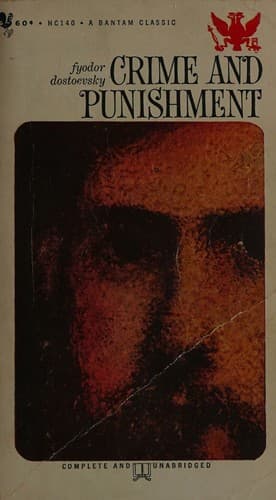
The Premise & Reading Vibe
Fyodor Dostoevsky’s *Crime and Punishment* is a feverish, psychologically claustrophobic masterpiece exploring guilt, morality, and the collapse of the rationalist 'superman' theory in the sweltering slums of 19th-century St. Petersburg.
Raskolnikov’s Axe & The Mental Siege
Rodion Raskolnikov, an impoverished former law student, convinces himself that extraordinary men are above common morality. Testing his theory, he murders an unscrupulous old pawnbroker with an axe.
The crime occupies only the opening chapters; the rest of the novel is a heart-pounding psychological siege. Hunted by the razor-sharp magistrate Porfiry Petrovich in a brilliant game of mental chess, Raskolnikov is tortured by fever, delirium, and unbearable isolation.
Sonya’s Faith & Spiritual Redemption
Raskolnikov’s salvation comes through Sonya Marmeladova, a gentle, deeply religious young woman forced into prostitution to support her starving family. Her sacrificial love and the reading of the biblical story of Lazarus offer Raskolnikov a path toward confession, exile in Siberia, and spiritual resurrection.
Key Highlights & Tropes
Psychological Breakdown: A terrifyingly accurate depiction of paranoia, guilt, and confession mania.
The Cat-and-Mouse Duel: Porfiry Petrovich’s conversational traps and psychological interrogation techniques.
The Extraordinary Man Theory: An early critique of moral relativism and nihilistic superiority.
Atmospheric St. Petersburg: Dusty yellow stairwells, stifling tavern corners, and crowded canal bridges.
The Critic's Note
The feverish interior monologues can feel intense, but they pull the reader directly into Raskolnikov’s racing, anxious mind, making it as suspenseful as any modern psychological thriller.
For Fans Of
Essential for readers of Franz Kafka’s *The Trial*, Albert Camus’ *The Stranger*, and Patricia Highsmith’s *The Talented Mr. Ripley*.