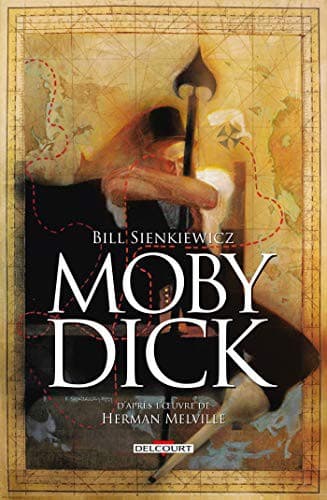
The Premise & Reading Vibe
Herman Melville’s *Moby-Dick* is the ultimate Great American epic—a staggering, encyclopedic blend of high-seas adventure, philosophical treatise, and cosmic tragedy charting one man’s maniacal pursuit of the sublime.
The Pequod & Captain Ahab's Quest
Opening with the iconic words 'Call me Ishmael,' the narrative follows a wandering schoolteacher who signs aboard the Nantucket whaling ship *Pequod*, befriending the Polynesian harpooner Queequeg.
Once at sea, the crew discovers the true, monomaniacal mission of the peg-legged Captain Ahab: to hunt down and slaughter Moby Dick, the legendary albino sperm whale that severed his leg, regardless of storm, mutiny, or divine omens.
Cosmic Symbolism & The Terrifying White Sea
Melville elevates a 19th-century commercial whaling voyage into a confrontation with the infinite. The White Whale becomes a blank canvas for human projection—fate, nature, God, or the cold indifference of the universe. The final three-day chase is one of the most thrilling climaxes in world literature.
Key Highlights & Tropes
Ahab’s Tragic Obsession: A monomaniacal leader willing to sacrifice his ship and crew for vengeance.
Ishmael and Queequeg's Brotherhood: A touching cross-cultural friendship forged in a crowded inn bed in New Bedford.
Maritime Realism: Detailed explorations of knot-tying, ambergris, blubber-stripping, and oceanic storms.
Shakespearean Grandeur: Soliloquies and stage directions that give whaling captains the gravity of King Lear.
The Critic's Note
The famous chapters detailing cetology (the scientific classification and anatomy of whales) slow the plot, but they are crucial for building the mythic, titanic scale of the whale before the final showdown.
For Fans Of
Essential for lovers of Ernest Hemingway’s *The Old Man and the Sea*, Joseph Conrad’s *Heart of Darkness*, and Nathaniel Philbrick’s *In the Heart of the Sea*.