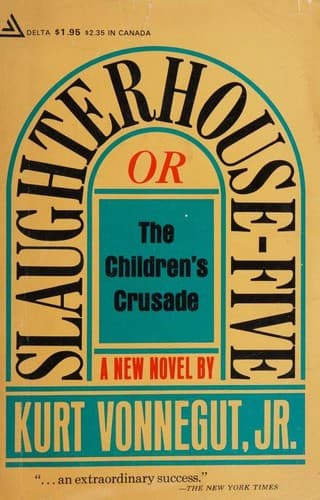
The Premise & Reading Vibe
Kurt Vonnegut’s *Slaughterhouse-Five* is an eccentric, darkly comedic anti-war classic blending post-traumatic stress, fatalistic philosophy, and sci-fi time travel. Centered on the firebombing of Dresden, it is a profound exploration of human frailty.
Billy Pilgrim & Becoming 'Unstuck in Time'
Billy Pilgrim, a meek American chaplain’s assistant captured during the Battle of the Bulge, survives the apocalyptic firestorm of Dresden while imprisoned in an underground meat locker (Slaughterhouse #5).
Traumatized by what he witnessed, Billy becomes 'unstuck in time'—jumping randomly between his capture in WWII, his mundane postwar suburban life as an optometrist in Ilium, New York, and his abduction by alien Tralfamadorians who display him in a zoo on their fourth-dimensional planet.
Tralfamadorian Fatalism: 'So It Goes'
Vonnegut’s famous refrain, 'So it goes,' appears over one hundred times—each uttered whenever death occurs, treating the demise of a glass of champagne, a louse, or an entire city of civilians with the same fatalistic detachment. It is a psychological defense mechanism against the unimaginable carnage of modern warfare.
Key Highlights & Tropes
Non-Linear Time Travel: A brilliant narrative device mirroring how trauma fractures memory.
Tralfamadorian Perspective: Viewing all moments in time simultaneously, eliminating fear of death.
Autobiographical Grounding: Vonnegut inserting himself into scenes: 'I was there. That was me.'
Dark Satirical Whimsy: Mixing absurd humor with devastating real-world history.
The Critic's Note
Short, episodic, and conversational, Vonnegut’s prose is disarmingly easy to read despite the gravity of its subject matter. It remains one of the most innovative novels of the 20th century.
For Fans Of
Essential for readers of Joseph Heller’s *Catch-22*, Kurt Vonnegut’s *Cat's Cradle*, and Philip K. Dick’s *VALIS*.