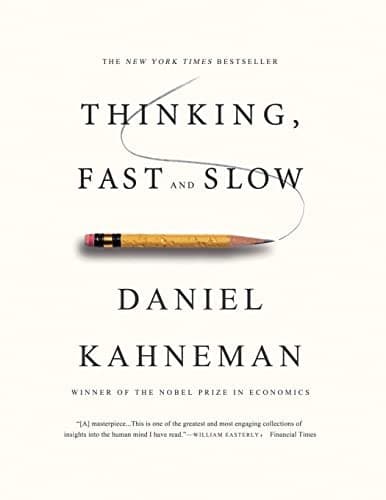
The Core Concept & Reading Vibe
Nobel laureate Daniel Kahneman’s *Thinking, Fast and Slow* is a landmark tour de force of behavioral economics and cognitive science. It dismantles the myth of the rational human actor, showing how cognitive biases shape our everyday decisions.
System 1 vs. System 2: The Two Modes of Thought
Kahneman introduces two foundational cognitive systems operating within the human brain:
• **System 1 (Fast Thinking):** Automatic, emotional, intuitive, and effortless (detecting hostility in a voice, reading billboards, driving on an empty road).
• **System 2 (Slow Thinking):** Deliberate, analytical, logical, and computationally lazy (solving 17 × 24, parallel parking in a tight spot, filling out tax forms).
Most human errors occur because lazy System 2 accepts the intuitive shortcuts (heuristics) generated by System 1 without checking.
Cognitive Biases & Prospect Theory
The book explores Kahneman and Amos Tversky's Nobel Prize-winning Prospect Theory: humans hate losses roughly twice as much as they enjoy equivalent gains (loss aversion). Key concepts like Anchoring, Availability Heuristic, Sunk Cost Fallacy, and WYSIATI ('What You See Is All There Is') provide an eye-opening lens on modern decision-making.
Core Pillars & Key Takeaways
Loss Aversion: The psychological pain of losing $100 is twice as intense as the joy of gaining $100.
WYSIATI Effect: System 1 constructs a confident narrative from whatever limited information is present.
The Framing Effect: How presenting facts (90% fat-free vs. 10% fat) fundamentally changes human response.
Experiencing Self vs. Remembering Self: The Peak-End rule determining how we recall past vacations or medical procedures.
The Critic's Note
Dense with academic experiments and statistics, it requires focused reading, but it fundamentally rewires how you think about your own brain.
For Fans Of
Essential for readers of Richard Thaler & Cass Sunstein’s *Nudge*, Nassim Nicholas Taleb’s *The Black Swan*, and Dan Ariely’s *Predictably Irrational*.